Project stage I 03.01.2025-31.12.2025
Synthesis and characterization of boron-silica-Cu nanoparticles (CuNPs) complex. Evaluation of fire-retardant material based on boron-silica-CuNPs complex deposited on wood and textile materials.
In this stage of the project, we developed and optimized a halogen-free fire retardant (FR) material composed of boron-silica complex and copper nanoparticles (CuNPs). This FR was then applied to wood and textile materials. The obtained FR coatings were characterized using appropriate characterization techniques. A set of minimum inhibitory concentrations for various antimicrobial strains was established.
Activity 1.1. Synthesis of Cu nanoparticles (CuNps)-CO
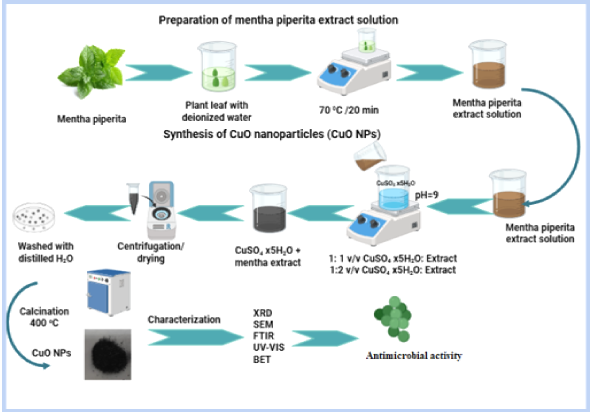
Copper oxide nanoparticles (CuO NPs) were synthesized through ultrasound-assisted green synthesis, using Mentha piperita leaf extract as a natural reducing and stabilizing agent. Mentha piperita is rich in bioactive compounds such as flavonoids, phenolic acids, and terpenoids, which can act as natural reducing, capping, and antimicrobial agents.
CuO NPs act as effective catalytic fillers in the field of fire retardancy. They facilitate the controlled thermal degradation of materials, promoting the formation of a stable char layer that serves as a protective barrier against heat and oxygen. Furthermore, CuO NPs are capable of scavenging free radicals generated during combustion, thereby effectively suppressing the propagation of flames.
Activity 1.2 Characterization and optimization of Cu NPs-CO
The synthesized CuO NPs were characterized using various techniques, such as UV-visible spectroscopy, X-ray diffraction (XRD), Fourier-transform infrared (FTIR) spectroscopy, scanning electron microscopy (SEM) coupled with EDX, and BET surface area analysis. Their thermal properties were evaluated through differential scanning calorimetry (DSC).
XRD and FTIR analysis confirmed the obtaining of CuO NPs.
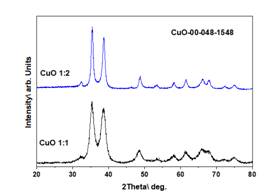
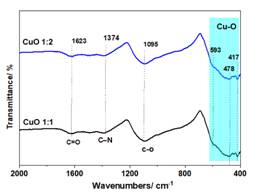
The crystallite size estimated using Scherrer eq. was 10 nm for CuO 1:1 and 15 nm CuO 1:2.
Activity 1.3 Microwave-assisted synthesis of boron-silica complex P1
The synthesis of the boron-silica complex was carried out via a microwave-assisted method and sol-gel method.
The microwave assisted method involves a two-phase process. This method enabled rapid and efficient integration of boron species into a silica matrix, aided by complexing and dispersing agents.
Phase I: Preparation of the Boron-Silica Precursor was carried out using boric acid, fumed silica, and ultrapure water. Triethylamine (TEA) was added to ensure a homogeneous dispersion and to prevent silica sedimentation.
Phase II: Preparation of Polymer Matrix Solution (PVA in ultrapure water).
The resulting mixture was then subjected to microwave irradiation, facilitating rapid synthesis through volumetric heating. This step promoted the formation of a homogenous boron-silica network and enhanced the interaction between boron species and the silica matrix.
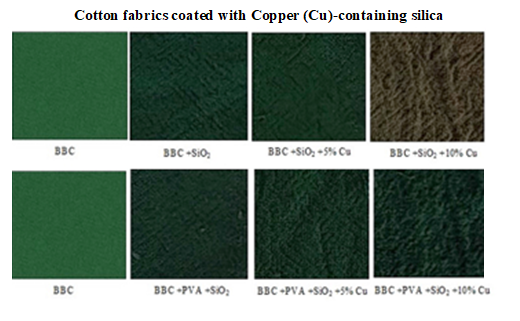
Copper (Cu)-doped silica coatings, were also prepared with and without polyvinyl alcohol (PVA) as a crosslinking agent, were synthesized via the sol-gel method using tetraethoxysilane (TEOS) as the silica precursor and copper (II) acetate dihydrate as the Cu source, and subsequently applied to textile fabrics.
Activity 1.4. Assembling boron-silica complex with copper nanoparticles via ultrasound process (CO, P)
CuO NPs at concentrations of 1 wt.% and 3 wt.% were successfully incorporated into the boron-silica complex matrix through an ultrasonic-assisted dispersion technique. This method facilitated uniform embedding of the nanoparticles within the hybrid network, enhancing the properties of the resulting material.
Activity 1.5 Characterization of the boron-silica complex embedded with copper nanoparticles (CO)
The obtained boron silica CuO NPs complex was characterized using the following techniques: X-ray diffraction (XRD), X-ray fluorescence spectroscopy (XRF), and infrared spectroscopy (FTIR).
Activity 1.6. Deposition of fire retardant on two types of conifers on two types of textile materials by spraying- CO, P
To apply fire-retardant coatings to pine and balsa wood, as well as textile fabrics, specimens measuring 50 x 50 mm and 50 x 150 mm were first immersed in prepared solutions at room temperature for 30 minutes. This was followed by a 15-minute sonication process. Afterward, the specimens were dried in an oven at 80ºC for 5 minutes and then cured at 170ºC for 2 minutes to ensure proper deposition of the fire-retardant coatings. The weight gain of the coated materials was then evaluated. Spraying the solution also yielded similar results for the wood types; however, the immersion method proved to be more effective for the textile fabrics.

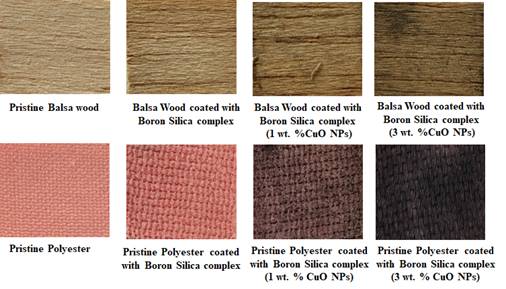
Activity 1.7 Surface characterization of the wood and textile materials before and after deposition of the fire retardant -CO
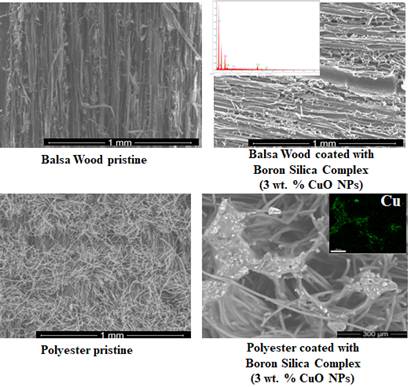
Wood and textile substrates were characterized before and after application of the fire-retardant using SEM, XRD, and FTIR analyses. SEM, combined with energy-dispersive X-ray spectroscopy (EDX), confirmed successful coating deposition on the surfaces and the presence of CuO NPs. XRD results indicated a reduction in the crystallinity of both wood and fabric following treatment. FTIR further validated the incorporation of the fire-retardant and revealed associated chemical modifications.
Activity 1.8 Evaluation of the adhesion of the fire retardant deposited on wood surface- CO,
The adhesion of the fire retardant was evaluated according to ASTM D3359.
Activity 1.9 Evaluation of antimicrobial activity- CO
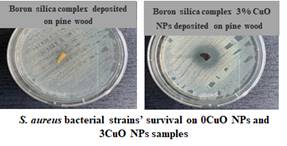
The antibacterial activity against Staphylococcus aureus (ATCC 25923) of the CuO NPs and the synthesized fire-retardant coatings was evaluated using the agar plate diffusion method and measuring bacterial growth inhibition by optical density readings.
CuO NPs (1:1) exhibited good antibacterial activity, as showed by the lower concentrations that inhibited bacterial proliferation.
In the case of fire-retardant coatings, samples with 3 wt. % CuO NPs effectively inhibited the growth of S. aureus, indicating their potential as a promising antibacterial formulation.
Activity 1.10 Dissemination of the results
The project website has been developed
The results were presented at the Journal of Thermal Analysis and Calorimetry Conference (June 24–27, 2025, Budapest, Hungary) and at the 8th International Conference on Emerging Technologies in Materials Engineering (October 6–7, 2025, Bucharest, Romania). In addition, an article has been submitted for publication in the Journal of Thermal Analysis and Calorimetry.